Choosing the right material for a light pole is rarely a simple specification exercise. Exposure conditions can change everything. A coastal road, mountain pass, and industrial yard create very different corrosion risks. Salt spray settles around base plates, bolts, seams, and cable access doors. Small details often fail before the pole shaft does.
What are the best materials for corrosion-resistant light poles? The practical answer depends on climate, structural loads, maintenance access, budget, and expected service life. Hot-dip galvanized steel offers strong structural performance and broad availability. Aluminum resists atmospheric corrosion and reduces handling weight, but it may require careful design against fatigue and galvanic contact. Stainless steel performs well in severe environments, although its higher cost needs justification. Fiberglass-reinforced polymer can be useful where electrical insulation and chemical resistance matter.
Material choice is only part of the protection strategy. Drainage, sealed connections, compatible fasteners, coating quality, and foundation design can determine actual field performance. I have seen durable poles develop premature rust because water remained trapped inside a poorly detailed base. That lesson is easy to overlook. It should not be.
This guide compares common materials through an engineering and maintenance perspective. It considers corrosion mechanisms, mechanical behavior, installation conditions, inspection needs, and lifecycle value. Recommendations should still be checked against local environmental data and applicable structural standards. No single material wins everywhere. Good design begins with honest site assessment, not a convenient product label.
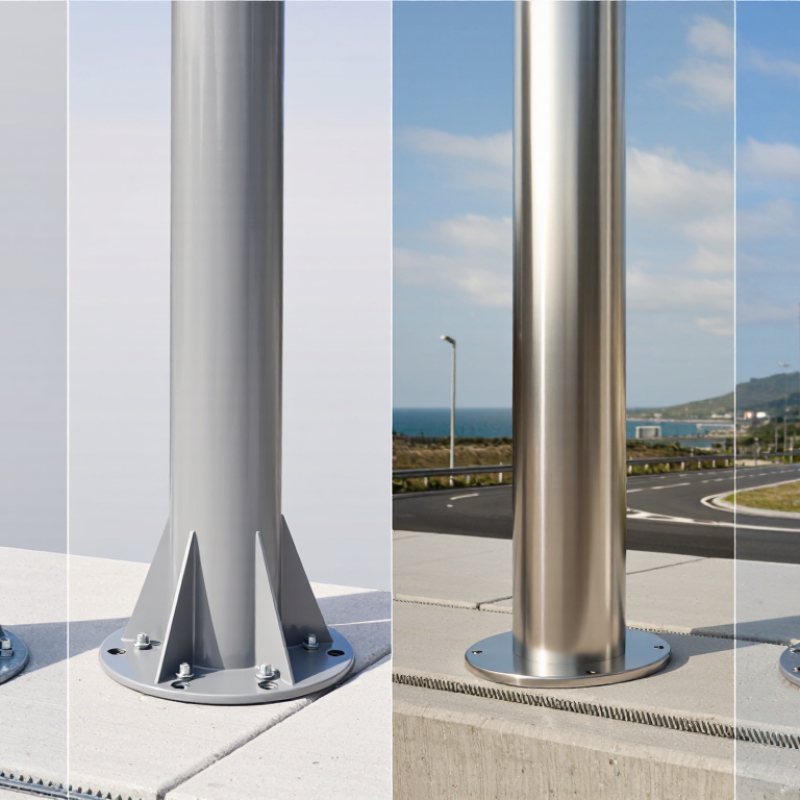
Corrosion risk starts with exposure, not the pole’s catalog material. Light poles face rain, condensation, road salt, industrial gases, and trapped dirt. Chloride ions are especially aggressive near coastlines and winter-maintained roads. They penetrate scratches, weld zones, threaded joints, and coating pores. The NACE IMPACT Study estimated global corrosion costs at US$2.5 trillion annually, equal to 3.4% of global GDP. The number is sobering. A Federal Highway Administration report also estimated US corrosion costs at US$276 billion annually, based on 1999 data.
ISO 9223 classifies atmospheric corrosivity from C1, very low, to CX, extreme. Coastal poles may face salt-laden moisture, while urban poles may encounter sulfur compounds and nitrogen oxides. These environments attack galvanized steel, aluminum, and painted surfaces differently. Steel can develop red rust after zinc depletion. Aluminum can pit beneath deposits, even when its surface looks intact. Dissimilar metals create galvanic cells around bolts, brackets, and base plates. Small drainage failures can keep these cells wet for days.
Material selection should follow site evidence. Record chloride exposure, wetness duration, pollution, temperature cycles, and soil contact. Inspect the base carefully; splash zones often deteriorate faster than upper shafts. A field checklist helps, but it is not perfect. Missed crevices can defeat an otherwise sound coating system. ASTM B117 salt-spray hours can compare coatings, yet they cannot reproduce every outdoor condition. Use test results cautiously, then verify details through inspections and maintenance records. Isolation washers, sealed joints, corrosion allowance, and proper drainage may matter as much as the alloy itself.
The chart uses ISO 9223 atmospheric corrosivity categories and the corresponding upper limits for first-year corrosion loss of low-carbon steel. Higher values indicate more aggressive exposure conditions. Coastal salt, industrial pollutants, persistent humidity, and de-icing salts can move a site into a higher-risk category and may require galvanized steel, aluminum, or stainless steel with suitable protective design.
How to Choose Corrosion Resistant Light Pole Materials
Material selection should begin with exposure, not appearance. The NACE IMPACT study estimated global corrosion costs at $2.5 trillion annually, equal to 3.4% of global GDP. Coastal salt, road de-icing chemicals, humidity, and trapped water can accelerate damage around pole bases and welded joints.
Galvanized steel offers strong structural performance and a zinc layer that protects exposed steel sacrificially. It suits highways, parking areas, and moderate industrial zones. However, cut edges, scratches, and poorly drained base plates still require inspection. Aluminum is lighter and naturally forms a protective oxide film. It performs well near many coastal sites, but lower stiffness may require thicker sections. Stainless steel provides excellent resistance, especially in chloride-heavy environments. Grade selection matters, because common lower-alloy grades can stain or pit near seawater. It also costs more and demands careful fabrication.
Powder-coated steel can improve appearance and barrier protection. It is not a complete corrosion strategy. Water beneath damaged coating may remain hidden. ISO 9223 recommends classifying atmospheric corrosivity before design, from low exposure to extreme marine conditions. Field inspections often find the pole base failing first, not the shaft. That detail changes the specification. Drainage, galvanic isolation, coating thickness, and fastener compatibility deserve equal attention. A practical mistake is treating “corrosion resistant” as permanent. Materials still need scheduled inspections, especially where salt accumulates.
Environmental conditions should guide material selection, not habit or purchase price. The NACE IMPACT study estimated global corrosion costs at approximately $2.5 trillion annually, equal to 3.4% of global GDP. Light poles face smaller surfaces, but failures can still disrupt roads, lighting, and public safety.
Start with a site assessment. Record humidity, rainfall, temperature cycles, salt exposure, air pollution, and soil chemistry. Coastal locations need special attention to chloride deposits, especially around bolts, seams, and base plates. ISO 9223 classifies atmospheric corrosivity from C1 to CX. A high-corrosivity site may require galvanized steel, aluminum, or stainless steel with suitable protection. However, material alone is not enough. Poor drainage can trap water inside a pole. Damaged coatings can expose steel within months.
Traffic corridors create another risk. De-icing salts can splash onto pole bases during winter. Industrial areas may add sulfur compounds and acidic moisture. The Federal Highway Administration has reported billions of dollars in annual bridge corrosion costs, showing how maintenance conditions influence infrastructure budgets. A light pole is not a bridge, but the lesson remains relevant.
Do not rely on a simple coastal-versus-inland rule. It is convenient, but incomplete. Inspect nearby structures, soil samples, and historical maintenance records before deciding.
Small design details matter. Rounded edges, sealed joints, and accessible drainage can extend service life. Specifications should also define coating thickness, inspection frequency, and repair methods.
No material choice is perfect. A cheaper pole may become expensive when corrosion appears at the base first.
How to Choose Corrosion Resistant Light Pole Materials
Coating selection should begin with the exposure environment, not the lowest purchase price. Coastal air, road salt, industrial moisture, and freeze-thaw cycles accelerate corrosion around pole bases. The NACE IMPACT study estimated global corrosion costs at $2.5 trillion annually, equal to about 3.4% of global economic output. That figure supports careful protection, but it does not justify excessive coating thickness.
For painted steel, specify a system under ISO 12944 and match it to the site category. Its durability ranges from under seven years to over 25 years, but these are planning periods, not warranties. Zinc-rich primers offer sacrificial protection, while epoxy layers resist moisture and polyurethane layers improve weather stability. Hot-dip galvanizing provides a robust zinc barrier, especially when drainage holes prevent trapped water. Duplex protection can extend service life, although damaged edges remain vulnerable. Small details matter.
During inspection, measure dry-film thickness at welds, corners, and the lower shaft. Check adhesion after curing. Look closely at the base plate, anchor bolts, and cable-entry openings. Corrosion often starts there. A flawless surface can still hide poor drainage. The American Galvanizers Association notes that zinc thickness varies with steel chemistry and section thickness, so certificates should be verified rather than assumed. I would also challenge one common habit: specifying the same treatment for every location. It is convenient, but rarely technically honest.
Choosing corrosion-resistant light pole materials starts with the maintenance plan, not the catalog. A coastal road faces salt spray, wind-driven moisture, and abrasive sand. Galvanized steel may suit accessible sites with scheduled inspections and coating repairs. Aluminum can reduce handling weight, but its connections need careful detailing. Small details matter.
For remote roads, campuses, or industrial yards, minimize visits and specialized equipment. A higher purchase cost may lower labor, traffic control, and replacement expenses. Specify drainage, sealed entry points, compatible fasteners, and isolation between dissimilar metals. Otherwise, hidden galvanic corrosion can develop around bolts and base plates. That failure is rarely dramatic at first.
Match the pole to inspection access, service life, budget, and local exposure conditions. Ask how technicians will reach the base after five winters, not just how it looks today. Review coating thickness, fabrication quality, weld treatment, and documented test methods with qualified engineers. Maintenance records often reveal more than a polished product sheet. I have seen good materials underperform when crews lacked clear repair procedures. The specification was sound. The maintenance plan was not.
| Material | Corrosion Resistance | Best-Fit Environment | Typical Maintenance Profile | Key Advantages | Important Limitations | Project Suitability |
|---|---|---|---|---|---|---|
| Hot-Dip Galvanized Steel | High when the zinc coating remains intact. Zinc provides sacrificial protection to exposed steel. | Urban roads, inland highways, industrial areas, and general outdoor installations. | Usually low routine maintenance; inspect coating damage, cut edges, weld areas, and drainage points. Repair damaged areas with an approved zinc-rich system. | Strong structural performance, widely available, and generally cost-effective for large projects. | Coating life depends on atmospheric exposure. Salt, acidic pollution, standing water, and poorly sealed crevices can accelerate zinc consumption. | A practical default for most standard roadway, parking, and municipal lighting projects. |
| Aluminum Alloy | Very good atmospheric corrosion resistance because aluminum forms a protective oxide layer. | Coastal areas, humid climates, parks, pedestrian zones, and projects where low weight is valuable. | Low routine maintenance; periodically inspect for pitting, surface deposits, fastener corrosion, and galvanic contact with dissimilar metals. | Lightweight, naturally corrosion resistant, and easier to transport and install than many steel alternatives. | Lower stiffness than steel may require larger sections. Direct contact with copper or incompatible metals can cause galvanic corrosion. | Suitable for weight-sensitive structures, decorative poles, coastal applications, and locations requiring simplified handling. |
| Stainless Steel 304 | Very good in many urban and rural atmospheres, but less resistant to chloride exposure than molybdenum-bearing grades. | Architectural projects, urban developments, clean industrial areas, and inland locations with moderate humidity. | Low maintenance when properly fabricated; wash off salt and pollutants where deposits accumulate, and avoid iron contamination during fabrication. | Durable metallic appearance, strong resistance to general atmospheric corrosion, and good long-term visual performance. | Pitting and crevice corrosion can occur in high-chloride or stagnant conditions. Surface finish and fabrication quality are important. | Appropriate when appearance is important and the site is not subject to severe marine salt exposure. |
| Stainless Steel 316 | Excellent resistance to chloride-related pitting compared with 304 because it contains molybdenum. | Marine environments, coastal promenades, harbors, de-icing salt zones, and high-humidity installations. | Low routine maintenance, but regular freshwater washing may be needed where airborne salt or road salt deposits are persistent. | Strong chloride resistance, durable appearance, and good performance where access for future repairs is difficult. | Higher material and fabrication cost. It is not immune to corrosion in severe crevices, stagnant saltwater, or contaminated weld areas. | A strong choice for long-life coastal and salt-exposed projects when lifecycle cost is more important than initial cost. |
| Fiber-Reinforced Polymer (FRP) | Excellent resistance to many salts, moisture, and atmospheric chemicals; performance depends on the resin and protective surface system. | Marine facilities, wastewater areas, chemical-processing surroundings, and electrically sensitive locations. | Low corrosion-related maintenance; inspect for UV degradation, impact damage, delamination, surface cracking, and weather-seal condition. | Lightweight, electrically nonconductive, and resistant to many aggressive environments. | UV exposure, fire requirements, impact behavior, connection design, and long-term structural data must be evaluated carefully. | Suitable for specialized corrosion-critical projects and sites where electrical insulation is required. |
| Weathering Steel | Moderate in suitable atmospheric conditions because a protective patina can form; not a universal marine solution. | Well-drained inland locations with alternating wet and dry exposure and limited salt contamination. | Requires inspection of patina development, water traps, joints, and runoff staining. Eliminate persistent wetness. | Can reduce the need for conventional paint systems and provides a distinctive architectural finish. | Performs poorly where continuously wet, exposed to marine chlorides, or subject to de-icing salts. Runoff may stain adjacent surfaces. | Consider only after confirming local climate, drainage, chloride exposure, and visual requirements. |
Rain, condensation, road salt, industrial gases, and trapped dirt create corrosion risks. Salt is especially aggressive near coasts and winter roads.
The base often fails before the upper shaft. Splash water, soil contact, and poor drainage keep this area wet.
Galvanized steel provides strong support and sacrificial zinc protection. It suits highways, parking areas, and moderately polluted locations.
Aluminum forms a natural oxide film that protects its surface. It can perform well near many coastal environments.
Stainless steel suits chloride-heavy locations and demanding coastal conditions. The selected grade matters because some lower-alloy grades may stain or pit.
No. Powder coating improves appearance and barrier protection, but damaged areas may trap water underneath.
Different metals can create galvanic cells around bolts, brackets, and base plates. Moisture makes this reaction more active.
Begin with site evidence, not appearance. Record salt exposure, wetness duration, pollution, temperature changes, and soil contact.
Laboratory salt-spray tests help compare coatings, but they cannot reproduce every outdoor condition.
Inspect bases, welds, threaded joints, coating damage, and drainage paths regularly. Remove trapped dirt and repair damaged protection promptly.
Choosing the right material for a light pole begins with understanding the specific corrosion risks it may face, including humidity, salt spray, industrial pollutants, standing water, and temperature changes. What are the best materials for corrosion-resistant light poles? Common options include galvanized steel, aluminum, stainless steel, and fiber-reinforced materials, each offering different levels of strength, durability, weight, cost, and corrosion protection. The best choice depends on the project’s location, expected service life, structural requirements, and budget.
Environmental conditions should be evaluated before selecting a material, especially in coastal, marine, urban, or chemically exposed areas. Protective coatings, surface treatments, sealed joints, drainage features, and corrosion-resistant fasteners can further extend service life. Finally, material selection should match the project’s maintenance capabilities and performance expectations. A slightly higher initial investment may provide greater long-term value by reducing inspections, repairs, recoating, and replacement needs.

Rhynox Lighting