What Is a High Mast Lowering System and How to Maintain It?

Time:2026-10-07 Author:Charlotte
0%

A high mast lowering system is more than a convenient lighting accessory. It is a service mechanism that brings high-mounted luminaires safely to ground level. Technicians can inspect lamps, cables, winches, pulleys, and electrical connections without relying entirely on elevated access equipment. That difference matters in highways, ports, sports grounds, and industrial yards.

“How to maintain high mast lowering systems?” The answer begins with disciplined, repeatable inspections. Michael J. O’Connor, a veteran high-mast maintenance engineer, states, “A lowering system is only reliable when its cable, winch, and locking points are checked as one system.” His observation reflects practical field experience. A damaged wire rope can overload the winch. A dry pulley can create uneven movement. A loose locking pin can turn a routine lowering operation into a serious hazard.

Maintenance should follow the manufacturer’s instructions and site risk controls. Check the wire rope for broken strands, corrosion, flattened sections, or birdcaging. Examine the winch drum and gearbox for leaks, unusual noise, and excessive backlash. Lubricate approved moving parts carefully. Do not over-grease them. Test the raising and lowering movement slowly, while watching for shaking, hesitation, or abnormal sounds.

Small faults are easy to dismiss.

That is where teams may become careless. Weather, vibration, salt air, and repeated cycling gradually weaken components. Keep inspection records with dates, findings, photographs, and corrective actions. A missed detail today may become an expensive failure later. Reliable maintenance is not only about extending equipment life. It protects workers, traffic, property, and the lighting system’s everyday performance.
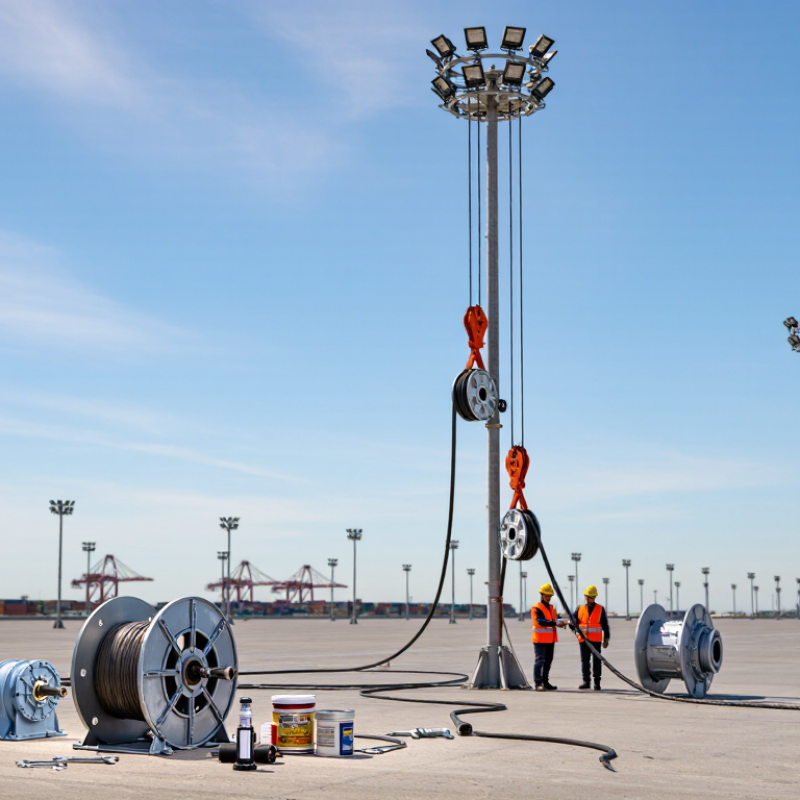
What Is a High Mast Lowering System and How to Maintain It?

What Is a High Mast Lowering System?

A high mast lowering system is a mechanical arrangement that brings elevated lighting equipment down to ground level. It is commonly installed on tall poles serving highways, ports, sports grounds, and large industrial yards. Instead of using a mobile lift for every inspection, technicians operate a winch, cable, and lowering carriage. The luminaire ring then travels safely down the mast for access.

The system usually includes stainless-steel cables, pulleys, guide rails, locking devices, and a ground-level operating unit. These parts must work together precisely. A damaged cable can create uneven movement or sudden loading.

In field inspections, small signs matter: frayed strands, unusual noise, water inside the winch box, or a carriage that stops too early. The mast may look sound while hidden components deteriorate. That is an easy mistake to make.

Tips: Keep the lowering area clear before operation. Check cable tension, fasteners, locks, and electrical isolation according to the maintenance manual. Clean exposed hardware, but avoid forcing grit into bearings. Test the system slowly and stop if movement becomes jerky. Only trained personnel should operate or repair it, using suitable fall protection and site controls. Maintenance records should include inspection dates, defects, measurements, and corrective actions. A practical review after severe wind is wise, even when the lights still operate.

Key Components and How the Lowering Mechanism Works

A high mast lowering system brings the luminaire assembly safely to ground level. Its main parts include a winch, gearbox, stainless-steel or galvanized cables, headframe, carriage, locking devices, and electrical connectors. The winch pulls the cable, moving the carriage down the mast. Mechanical latches then secure the carriage for servicing. Raising it reverses the process. The mechanism sounds simple. Alignment makes it reliable.

Field technicians should inspect cable strands, sheaves, bolts, and latch engagement before every lowering operation. Look for flattened wire, corrosion, unusual noise, or uneven movement. The U.S. Department of Energy’s 2023 Solid-State Lighting R&D Opportunities report records laboratory LED efficacy above 200 lumens per watt. That reduces lamp replacement frequency, but it does not remove mechanical risk. A neglected cable can still fail. I have seen teams clean fixtures carefully, yet overlook a dry gearbox. That mistake deserves more attention.

Tips: Keep a service log with dates, weather, cable condition, and measured operating time. Follow the structure’s engineering manual and applicable inspection standards. Lubricate only approved points; excess grease can trap grit. Test the lowering cycle slowly, without personnel beneath the carriage. Recheck latch engagement after raising. A checklist helps, but it is not perfect. Human judgment still matters.

High Mast Lowering System: Key Components and Maintenance Intervals

A high mast lowering system uses a winch, wire rope, pulley assembly, carriage, locking mechanism, and electrical connections to safely lower the luminaire ring for ground-level servicing. The intervals below represent typical preventive-maintenance frequencies; always follow the site risk assessment and equipment manufacturer’s instructions.

Step-by-Step Procedure for Lowering and Raising a High Mast

A high mast lowering system lets technicians bring a lighting crown to ground level without climbing the tower. This improves access to luminaires, wiring, and mechanical parts. The U.S. Department of Energy’s 2023 solid-state lighting report identifies laboratory LED efficacy above 200 lumens per watt. However, efficient lamps still need safe inspection and accurate aiming.

Before lowering, isolate the electrical supply and confirm zero voltage with a tested meter. Establish a barricaded work zone around the mast. Inspect the winch, gearbox, cable, locking device, and guide rollers. Check the manufacturer’s load rating against the actual crown weight. Remove loose tools and verify that the lowering cable sits correctly on the drum. Small errors matter.

Release the locking mechanism gradually, then operate the winch at a controlled speed. Keep personnel outside the crown’s travel path. Stop if the cable jumps, twists, or produces unusual noise. At ground level, inspect connectors for moisture, terminals for heat damage, and bolts for corrosion. Clean contact surfaces carefully, then replace damaged seals or frayed cable. The FHWA Lighting Handbook recommends scheduled inspection and maintenance for roadway lighting systems, while NFPA 70B emphasizes documented electrical maintenance. Raise the crown slowly after testing each luminaire. Re-engage the lock, restore power, and check illumination from the roadway. I sometimes find incomplete maintenance records. That weakness deserves attention. Record the date, readings, defects, repairs, and technician’s name for the next service cycle.

What Is a High Mast Lowering System and How to Maintain It? - Step-by-Step Procedure for Lowering and Raising a High Mast

Step Operation or Maintenance Task Typical Frequency or Timing Recommended Method and Key Data Acceptance Criteria Safety Requirement Status
1 Review the equipment documentation Before every lowering or raising operation Confirm the mast height, headframe arrangement, winch type, cable routing, rated load, brake instructions, and approved operating procedure. All personnel understand the procedure, and the actual equipment matches the documentation. Use the manufacturer’s instructions whenever they differ from general guidance. Required
2 Check the weather and work area Before each operation Do not lower the headframe during lightning, ice accumulation, strong gusts, heavy rain, or poor visibility. Establish an exclusion zone around the mast. Weather is suitable, the ground is stable, and no person, vehicle, or obstacle is beneath or near the moving assembly. Apply site traffic control and prevent unauthorized access. Required
3 Isolate the electrical supply Before opening the electrical cabinet or handling wiring Switch off the lighting circuit and control power. Lock out and tag out the isolator. Verify absence of voltage with a suitable tester. No unexpected electrical energy is present, and the lockout is controlled by the authorized worker. Electrical isolation does not replace mechanical control of the headframe and winch. Required
4 Inspect the mast and foundation Before each lowering operation; detailed inspection at least annually Look for corrosion, cracks, deformation, loose bolts, damaged welds, water ingress, foundation movement, and damaged access covers. No structural damage, excessive corrosion, loose fasteners, or foundation movement is visible. Do not operate a mast with suspected structural damage until assessed by a competent person. Inspect
5 Inspect the winch, wire rope, pulleys, and connectors Before every operation; detailed examination according to site risk assessment Check for broken wires, kinks, flattening, birdcaging, corrosion, damaged sheaves, worn bearings, loose pins, and deformed attachment points. Wire rope runs freely and shows no defect requiring removal. Sheaves rotate smoothly and connectors are secure. Never use a damaged wire rope or bypass a rope limit switch. Inspect
6 Inspect the headframe and lowering guides Before every lowering operation Verify that luminaires, brackets, bolts, guide rollers, guide shoes, locking devices, and cable connections are secure and correctly aligned. The headframe is balanced, guide components are intact, and no loose item can fall during movement. Use suitable fall-protection and lifting controls when working at height. Inspect
7 Release the mechanical locking system At the start of the lowering procedure Remove or disengage the headframe locking pins, clamps, or retaining mechanism only after the area is secured and the winch is ready to control the load. Locking components release without excessive force and the headframe remains supported by the lowering system. Never stand beneath the headframe or place hands near pinch points. Required
8 Lower the headframe in a controlled manner During every lowering operation Operate the winch slowly and smoothly. Keep the headframe level, monitor the wire rope, and stop immediately if binding, unusual noise, swinging, or uneven movement occurs. Movement is steady, controlled, and free from shock loading or uncontrolled descent. Only trained personnel may operate the winch. Keep the exclusion zone active. Required
9 Secure the lowered headframe Before inspection, cleaning, or lighting work Place the headframe on its designated support or secure it with approved restraints. Do not rely solely on the winch brake to support personnel or equipment. The headframe is stable and cannot roll, slide, swing, or rise unexpectedly. Keep the winch controls isolated when the headframe is being serviced. Required
10 Perform maintenance at ground level As needed; commonly during scheduled inspections Clean luminaires, replace failed lamps or LED modules, tighten approved fasteners, inspect gaskets, check connectors, lubricate designated moving parts, and remove corrosion products. Components are clean, sealed, correctly fastened, and replaced with parts of the correct rating and compatibility. Do not modify the headframe, wiring, or load arrangement without engineering approval. Maintain
11 Raise the headframe After maintenance is complete Remove tools and temporary restraints. Operate the winch slowly while checking alignment, guide engagement, cable tracking, and clearance from the mast. The headframe reaches the operating position without binding, twisting, impact, or abnormal noise. Stop the operation if any person enters the exclusion zone. Required
12 Re-engage the locking mechanism At the end of every raising operation Fully install locking pins, clamps, or other approved retainers. Confirm that the load is transferred from the winch system to the mechanical support. All locking devices are fully seated, secured, and visually confirmed by the operator. Never leave the headframe elevated without its mechanical locking system engaged. Required
13 Test the lighting and controls After every maintenance operation Restore power after all personnel are clear. Test lighting circuits, photocell or timer functions, control switches, and any limit or interlock devices. Lights operate correctly, protective devices function, and no alarm, overheating, or abnormal noise is observed. Keep cabinet doors closed and maintain electrical protection against moisture and unauthorized access. Verify
14 Record the inspection and maintenance results After every operation and during scheduled inspections Record the date, personnel, weather, defects found, wire-rope condition, repairs, replacement parts, test results, and next inspection date. Records are complete, traceable, and any unresolved defect has a documented corrective action. Remove the mast from service when a safety-critical defect cannot be corrected immediately. Document
Important: Inspection intervals, allowable wire-rope wear, torque values, wind limits, rated loads, electrical tests, and replacement requirements must be confirmed against the specific high mast design, applicable local regulations, and the approved maintenance manual.

Routine Inspection and Preventive Maintenance Practices

What Is a High Mast Lowering System and How to Maintain It?

A high mast lowering system brings tall lighting equipment safely to ground level for inspection and repair. It commonly includes a winch, wire rope, pulleys, locking hardware, and a lowering carriage. Routine inspection should begin with a visual check around the mast base. Look for rust, water entry, loose bolts, cracked welds, and damaged covers. Examine the wire rope for broken strands, flattening, birdcaging, or unusual corrosion. Test the winch slowly, listening for grinding or irregular movement. Stop immediately if the carriage jerks or fails to lock.

Preventive maintenance should follow the equipment manual and site safety procedure. Clean dirt from the winch and drainage points before applying suitable lubricant. Check rope tension, pulley alignment, electrical connections, and mechanical fasteners. A qualified technician should verify torque settings and inspect internal components at scheduled intervals. Record each finding, even minor ones. A checklist may look complete while hidden wear continues inside the mechanism. That weakness deserves attention.

Tips: Keep the mast area clear during lowering. Never stand beneath suspended equipment. Use calibrated tools for critical fasteners. Photograph damaged parts before repair. Replace questionable wire rope rather than extending its service life. Test the emergency stop and locking device during controlled maintenance. Do not rely on noise alone; some failures develop quietly. Review inspection records after severe wind, flooding, or accidental impact. Small oversights can become expensive, and maintenance teams should challenge their own assumptions.

Safety Checks and Common System Troubleshooting Methods

What Is a High Mast Lowering System and How to Maintain It?

A high mast lowering system lets technicians bring a tall lighting column down for safer maintenance. It may use a winch, stainless-steel cables, a carriage, and locking components.

Before opening any panel, isolate the power supply and secure the work area. Check wind conditions, traffic movement, and ground stability. A small mistake can create a serious falling-object hazard.

Keep the system clean and dry. Inspect cables for broken strands, rust, bird damage, or uneven tension. Examine pulleys, fasteners, guide rails, and locking pins for wear. Lubricate only with the specified product. Too much lubricant can collect grit. Test the lowering movement slowly, without people standing beneath the mast. Record unusual sounds and the inspection date.

Listen carefully.

A humming motor with no movement may indicate a jammed carriage, weak power supply, or damaged gearing. If the mast lowers unevenly, check cable tension and pulley alignment. A sudden stop can involve a limit switch, control fault, or mechanical obstruction.

Never bypass a safety switch to save time. That shortcut can hide a deeper failure.

In field work, technicians sometimes replace a visible part too quickly. The real problem may be water inside a connection or a loose terminal. When uncertainty remains, stop testing and use a qualified service professional with suitable lifting and electrical experience.

FAQS

What is a high mast lowering system?

It brings a tall lighting crown to ground level without requiring tower climbing. The system may include a winch, wire rope, pulleys, a carriage, and locking hardware. This provides safer access to lamps, wiring, and mechanical parts.

What should technicians do before lowering the lighting crown?

Isolate the electrical supply and confirm zero voltage with a tested meter. Create a barricaded zone around the mast. Check wind, traffic, ground stability, and the crown’s travel path. Remove loose tools and keep people away from suspended equipment.

Which components require inspection before operation?

Inspect the winch, gearbox, cable, guide rollers, pulleys, locking device, and fasteners. Look for broken strands, flattening, birdcaging, rust, loose bolts, and cracked welds. Compare the equipment load rating with the actual crown weight. Small errors matter.

How should the crown be lowered safely?

Release the locking mechanism gradually and operate the winch at a controlled speed. Keep everyone outside the crown’s travel path. Stop if the cable twists, jumps, jerks, or makes unusual noises. Never stand beneath the crown.

What should technicians inspect when the crown reaches ground level?

Check connectors for moisture and terminals for heat damage. Inspect bolts for corrosion, seals for damage, and cables for fraying. Clean contact surfaces carefully. Replace questionable wire rope instead of extending its service life.

How can uneven lowering or sudden stops be investigated?

Check cable tension, pulley alignment, guide rails, and mechanical obstructions. A humming motor without movement may indicate a jammed carriage or damaged gearing. A sudden stop may involve a limit switch or control fault. Do not bypass a safety switch.

What maintenance practices help prevent future failures?

Keep the winch and drainage points clean and dry. Use only the specified lubricant, because excess lubricant can collect grit. Test the emergency stop and locking device during controlled maintenance. Use calibrated tools for critical fasteners.

What records should be kept after inspection and repair?

Record the date, voltage readings, defects, repairs, and technician’s name. Photograph damaged parts before repair when practical. Review records after severe wind, flooding, or accidental impact. Incomplete records are common. That weakness deserves attention.

When should a qualified service professional be called?

Stop testing when the cause of a fault remains uncertain. Professional help is appropriate for internal mechanisms, electrical faults, damaged gearing, or unstable movement. A visible replacement part may not solve the real problem. Water inside a connection can remain hidden.

Conclusion

A high mast lowering system is a mechanical arrangement that allows a tall lighting, communication, or monitoring mast to be safely lowered to ground level for inspection, lamp replacement, and repairs. Its main components typically include a winch, lifting cable, pulley assembly, carriage, locking devices, and electrical connections. During operation, the winch controls the cable tension while the carriage moves smoothly along the mast. Operators should follow a clear step-by-step process: isolate power, inspect the area, release the locking mechanism, lower the carriage steadily, complete the required work, and then raise and secure the mast carefully.

How to maintain high mast lowering systems? Conduct routine checks for cable wear, corrosion, loose fasteners, damaged pulleys, abnormal noise, and uneven movement. Lubricate approved moving parts, keep the winch and access points clean, and verify that safety locks and electrical connections function correctly. Before each operation, confirm that personnel remain clear of the danger zone and that weather conditions are suitable. If the system jams, slips, or makes unusual sounds, stop immediately, secure the mast, identify the cause, and arrange qualified technical service before returning it to operation.

Charlotte

Charlotte

Charlotte is a seasoned marketing professional with a deep understanding of the company's portfolio and a passion for elevating its presence in the market. With a keen eye for detail and a commitment to excellence, she ensures that our professional blog is regularly updated with insightful articles......