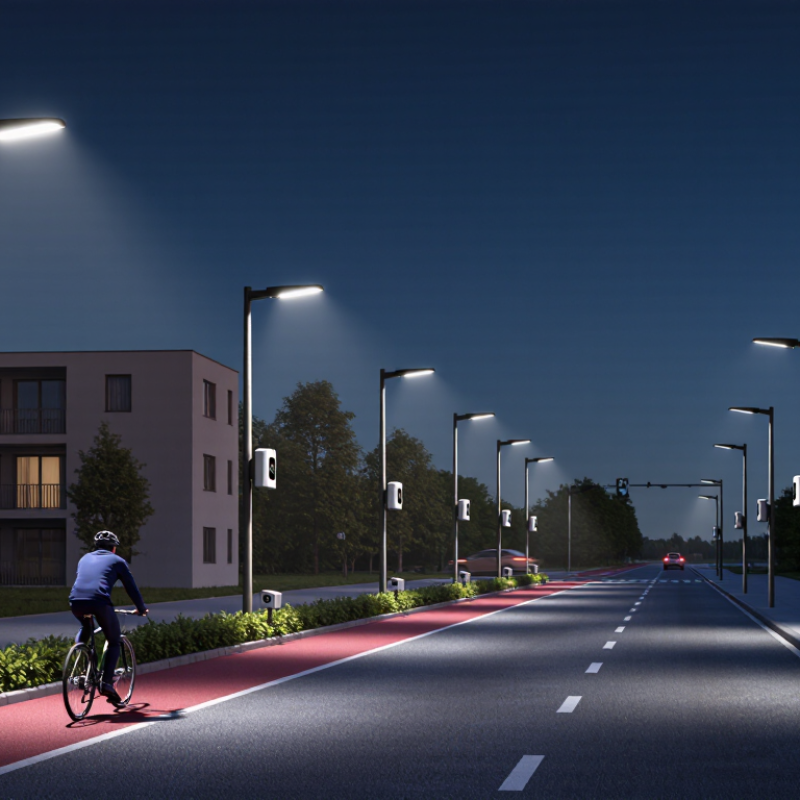
| Urban streets with frequent pedestrians and bicycles |
Passive infrared (PIR) with optional microwave confirmation |
Approximately 8–15 m, depending on lens, mounting height, and temperature contrast |
Install on the luminaire or pole and connect to a dimmable LED driver through a lighting controller |
Low power use, simple commissioning, effective for people entering a defined area |
Performance can decrease when moving people have little temperature contrast with the background |
Maintain a low standby level, raise output when motion is detected, and keep the light at the higher level for 30–90 seconds after the last event |
| Two-lane roads with mixed vehicle speeds |
24 GHz or 60 GHz microwave radar |
Commonly 15–40 m for vehicle detection; final range depends on antenna pattern and installation height |
Use directional aiming along the lane and connect event data to a local or wireless lighting-control network |
Detects motion in darkness and is less dependent on visible light or surface color |
May detect vehicles or movement outside the intended zone if the field of view is not carefully controlled |
Use separate approach and departure zones, with speed-based hold times to reduce repeated switching |
| Highways, ramps, and long detection corridors |
Long-range radar or radar with multiple detection zones |
Often 30–80 m per controlled zone; actual coverage must be verified by field testing |
Link several luminaires into adaptive lighting groups with overlapping zones |
Supports gradual light progression before a vehicle reaches each pole and reduces abrupt brightness changes |
Requires careful alignment, filtering, and coordination to prevent cross-lane or adjacent-road triggers |
Use overlapping zones and a short fade transition, while retaining a safety minimum level during low traffic |
| Parking areas and access roads with irregular traffic |
Radar combined with PIR or video-based analytics |
Approximately 10–30 m for pole-mounted detection; coverage depends strongly on obstacles and layout |
Group nearby fixtures and use occupancy events to activate zones rather than individual lamps only |
Handles varied movement patterns and can reduce false triggers through sensor confirmation |
Video systems require privacy controls, suitable lighting, and additional processing equipment |
Use radar for primary presence detection and a second sensing method where pedestrian and vehicle paths overlap |
| Open roads exposed to strong wind and moving vegetation |
Microwave radar with motion filtering |
Approximately 15–40 m, subject to antenna direction and filtering settings |
Aim the sensor away from trees, signs, and loose roadside objects; process events locally where possible |
Works in darkness and is generally less affected by moving shadows or changes in daylight |
Wind-driven objects can still create detections if they enter the active field |
Set minimum target speed, use directional filtering, and validate detection during windy conditions |
| Fog, rain, snow, and rapidly changing visibility |
Radar, optionally paired with a visibility or ambient-light sensor |
Approximately 15–40 m for common road applications; snow accumulation can reduce effective coverage |
Combine motion events with weather-based lighting rules and a conservative minimum brightness |
Radar can continue detecting objects when cameras and optical sensors lose contrast |
Heavy wet snow, ice, or water on the sensor enclosure may affect detection and must be managed |
Use a weather-rated enclosure, a heated or protected lens where necessary, and scheduled inspection after severe weather |
| Hot climates with high ambient temperatures |
Radar or dual-technology radar plus PIR |
Approximately 10–40 m, depending on technology and mounting arrangement |
Use radar as the primary trigger and PIR as confirmation where pedestrian detection is important |
Radar does not rely on body heat and can provide more consistent detection in small temperature differentials |
Electronics and batteries require temperature ratings appropriate for the local climate |
Select equipment rated for the expected ambient range, provide ventilation where appropriate, and avoid direct solar loading |
| Tunnels, covered roads, and enclosed underpasses |
Radar, with optional video analytics for incident verification |
Approximately 10–40 m per zone, determined by tunnel geometry and mounting height |
Connect sensors to zoned lighting controls and retain a separate emergency-lighting system |
Operates without dependence on daylight and supports predictable zone-by-zone control |
Sensor failure must not compromise required safety or emergency illumination |
Use fail-safe defaults, redundant detection for critical areas, and lighting controls compliant with local road-safety requirements |
| Residential streets where glare and light spill must be limited |
Low-power PIR or short-range radar with gradual dimming |
Approximately 6–15 m for pedestrian-focused coverage |
Control each luminaire or a small group with programmed ramp-up and ramp-down transitions |
Reduces unnecessary light, energy use, and disturbance while maintaining responsive illumination |
Short detection zones may require more luminaires or overlapping coverage |
Keep a modest background level, use a 5–15 second fade, and apply a 60–120 second occupancy hold time |
| Remote roads with limited power and communications |
Standalone PIR or radar with local control logic |
Approximately 8–30 m, depending on the selected sensor and mounting height |
Use local scheduling and sensor control; add wireless networking only where power and signal budgets allow |
Reduces dependence on a central server or continuous network connection |
Limited remote diagnostics and configuration; battery-powered systems require energy budgeting |
Use a defined fail-safe light level, low-power standby mode, and periodic maintenance checks |
 Rhynox Lighting