Cities are replacing fixed streetlights with connected, responsive infrastructure. The International Energy Agency reports that lighting uses about 15% of global electricity. That figure gives municipalities a practical reason to modernize. It also creates pressure to measure results honestly.
So, what are the latest trends in smart city lighting? Buyers are watching seven developments closely: networked LED luminaires, adaptive dimming, wireless controls, AI-supported traffic sensing, solar and hybrid power, open interoperability standards, and stronger cybersecurity. The U.S. Department of Energy’s LED research shows continuing gains in efficacy, reliability, and lifecycle performance. Meanwhile, the Global Smart City Market reports from MarketsandMarkets identify connected infrastructure as a major urban investment area. These reports suggest momentum, not guaranteed success.
Lighting strategist Rogier van der Heide, whose work includes urban and architectural lighting, has said, “Light is the fourth dimension of architecture.” His observation still matters when a lamp becomes a sensor, communication node, and public-safety asset. Smart lighting should improve streets, not merely decorate them with technology.
The details are tangible. A pathway may brighten when pedestrians approach. A maintenance team may receive a fault alert before a dark junction causes complaints. Yet this picture is not perfectly clean. A sensor can misread fog, while an inexpensive controller may create expensive integration problems. Global buyers therefore need more than impressive demonstrations. They need measurable energy data, clear cybersecurity practices, compatible protocols, local maintenance support, and realistic payback assumptions. This guide examines the seven trends shaping that decision.
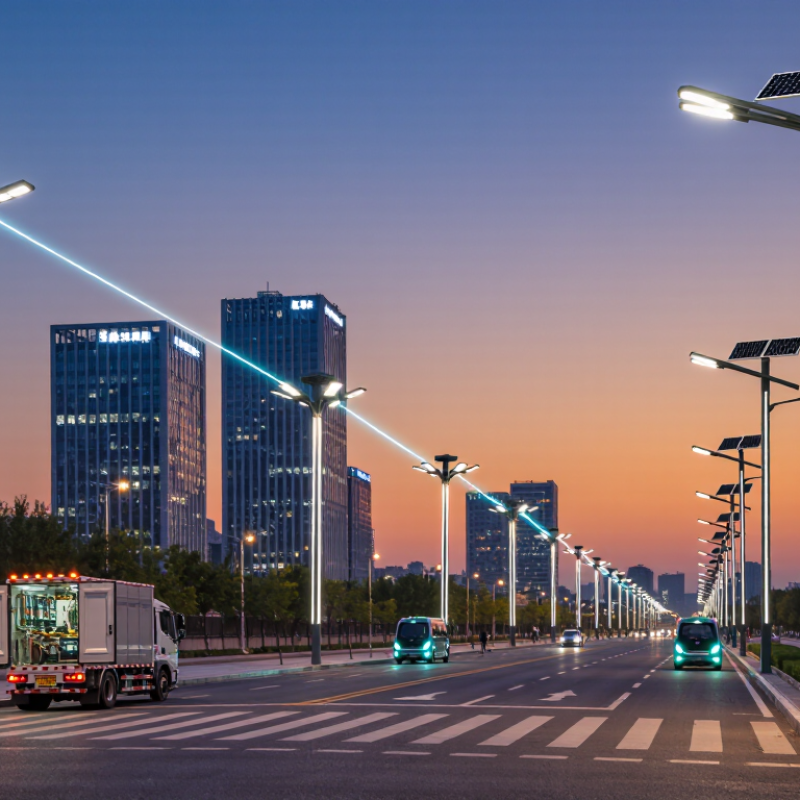
Smart city lighting is more than replacing old lamps with LEDs. It combines efficient fixtures, sensors, controls, connectivity, and urban data. A typical street may use adaptive dimming, pedestrian detection, traffic monitoring, and remote fault alerts. The system reacts to real conditions instead of following a fixed schedule. This can reduce energy waste and improve visibility near crossings, bus stops, and residential streets. However, connected equipment is not automatically smart. A poorly maintained control cabinet can become an expensive weak point.
The global market is moving toward seven practical trends: networked controls, adaptive brightness, solar-assisted systems, edge analytics, interoperable platforms, stronger cybersecurity, and human-centered illumination. Buyers should examine more than purchase price. Check maintenance access, operating temperature, spare-part availability, data ownership, and local electrical requirements. A pilot project on one avenue can reveal communication gaps before citywide installation. Energy savings also depend on traffic patterns, weather, and maintenance quality. Perfect forecasts are impossible.
Request measured performance data, not only projected savings. Define uptime, response time, and repair responsibilities in writing. Test dimming around homes and pedestrian areas. Consult local engineers and residents before expansion. Small trials often expose inconvenient truths.
7 Best Smart City Lighting Trends for Global Buyers?
Connected LED Networks and Adaptive Lighting Controls
Connected LED networks are changing how cities manage streets, parks, and public facilities. Each fixture can report energy use, operating hours, faults, and temperature through a secure management platform. Maintenance teams see failures before residents report dark sidewalks. That reduces inspection trips and supports more reliable service.
Adaptive lighting controls adjust brightness according to movement, weather, time, and local safety policies. A quiet road may use lower output after midnight. Motion sensors can raise illumination within seconds when pedestrians or vehicles appear. In busy areas, scheduled lighting scenes help balance visibility, energy demand, and neighborhood comfort. Buyers should examine sensor accuracy, network coverage, cybersecurity procedures, and compatibility with existing infrastructure.
Small details matter. A cabinet near a coastal road needs protection from salt air. A control unit in a cold region requires tested temperature performance. Open communication standards can also reduce dependence on one supplier. Yet adaptive systems are not flawless. Sensors may miss cyclists, react to animals, or create uneven brightness between adjacent fixtures. Field trials should measure lighting levels, response times, maintenance workload, and public feedback. A careful pilot often reveals problems that a sales presentation cannot. Procurement teams should request documented test methods, realistic energy estimates, and clear data ownership terms before approving a citywide rollout.
Smart city lighting is moving beyond simple LED replacement. Global buyers now look for renewable energy systems that reduce operating costs and maintain reliable nighttime visibility. Solar streetlights combine photovoltaic panels, lithium batteries, efficient LEDs, and intelligent controls. In sunny regions, this design can operate independently from the grid. However, local weather matters. Dust, monsoon clouds, snow, and short winter days can reduce energy collection.
Energy-efficient design begins with accurate site data. Lighting engineers should study road width, pedestrian movement, pole spacing, and seasonal sunlight. Adaptive dimming can lower brightness during quiet hours and increase it when sensors detect movement. Remote monitoring helps teams identify battery decline, panel damage, or unusual energy consumption before failures become visible. Small details matter. A poorly aimed panel can waste valuable generation capacity.
Global buyers should request verified photometric data, battery cycle information, ingress protection ratings, and clear maintenance procedures. Independent testing improves confidence, especially when projects cross different climates and regulations. Hybrid systems may suit locations with frequent cloudy weather, while modular batteries can simplify future upgrades. Solar lighting is not automatically sustainable; oversized equipment, premature battery replacement, and difficult repairs can create hidden waste. Procurement teams should compare total lifecycle costs, not only the purchase price. Field experience also suggests allowing a practical reserve, because real streets rarely match perfect design assumptions.
Energy-efficient lighting benchmarks for renewable-energy, solar-system, and smart-control planning.
Compared with a standard incandescent lamp, halogen lighting typically uses about 30% less energy, compact fluorescent lighting uses about 75% less, and LED lighting uses about 75% less while lasting up to 25 times longer. For smart-city projects, LED systems can be combined with dimming, occupancy sensing, adaptive controls, and solar power to reduce operating costs and grid dependence.
Source: U.S. Department of Energy, Energy Saver guidance on lighting efficiency and service life. Values are normalized benchmarks; incandescent energy use = 100 and service life = 1.
Smart city lighting is moving beyond fixed schedules and basic energy savings. Adaptive dimming now responds to traffic, weather, and pedestrian movement. IoT sensors can detect occupancy, temperature, vibration, and lamp performance in near real time. Data tells stories. A quiet road at midnight should not receive the same output as a busy transit corridor.
For global buyers, data analytics should support clear operational decisions. A central platform can compare energy use, outage frequency, and maintenance response across districts. Edge processing can reduce network delays and limit unnecessary data transfers. Predictive lighting management uses historical faults to estimate when drivers, power units, or communication nodes may fail. Maintenance teams can then replace parts during planned visits, rather than waiting for dark streets and public complaints.
Interoperability matters as much as sensor accuracy. Buyers should request open interfaces, documented data ownership, cybersecurity controls, and exportable reports. Personal information must be minimized, anonymized, and handled according to local requirements. Field testing remains essential because laboratory results rarely reflect dust, flooding, unstable networks, or seasonal traffic. No model is perfect. A pilot may reveal false occupancy alerts or confusing dashboards, but those weaknesses are valuable before a city-wide purchase. Reliable projects also measure lighting quality, not only kilowatt savings, using consistent procedures and independent verification.
For global buyers, smart city lighting now requires measurable procurement standards, not attractive pilot displays. The International Energy Agency reported that LEDs represented about 50% of global lighting sales in 2022, up from roughly 5% in 2015. Buyers should specify verified lumen maintenance, power-factor performance, cybersecurity controls, and open communication protocols. ISO 37120 can support wider city-performance benchmarking, while interoperable controls reduce dependence on one supplier.
Regional needs remain decisive. In dense Asian cities, adaptive dimming can respond to traffic, rain, and pedestrian movement. European tenders often emphasize circularity, repairability, and energy reporting. In Africa and remote regions, solar compatibility, battery replacement, and simple maintenance may matter more than advanced analytics. The World Bank notes that nearly 70% of the world’s population may live in cities by 2050, increasing pressure on reliable public infrastructure. One design rarely fits every climate.
Future development is moving toward edge sensors, digital twins, and lighting networks that share data with transport and emergency services. However, procurement teams should avoid buying complexity without local technicians. The UNEP 2023 Global Status Report states that buildings consume about 30% of global final energy, making efficient controls commercially relevant. Yet projected savings can disappoint when sensors are poorly positioned or schedules remain unchanged. Field trials, independent measurement, and clear maintenance responsibilities are still necessary. Smart is not always practical.
It combines efficient fixtures, sensors, controls, connectivity, and urban data. Lights can adjust brightness, detect movement, and report faults remotely. LED replacement alone is not enough.
Sensors monitor traffic, pedestrians, weather, and occupancy. The system increases brightness near crossings or busy bus stops. It dims quiet residential streets at suitable hours. The response may not always be perfect.
Systems may track energy use, lamp performance, temperature, vibration, and outages. Some sensors detect pedestrian or vehicle movement. Personal information should be minimized and anonymized. Less data is often safer.
Predictive tools study repeated faults and estimate possible component failures. Crews can replace parts during planned visits. This may reduce dark streets and emergency repairs. Predictions can still be wrong.
Open interfaces help lighting systems communicate with other platforms. They can simplify future upgrades and data exports. Buyers should confirm data ownership and reporting formats. Closed systems may create costly limitations.
Run a pilot on one avenue or district. Test dimming near homes, crossings, and pedestrian areas. Check communication gaps, flooding, dust, and unstable networks. Small trials reveal inconvenient truths.
Request measured energy data instead of relying only on projected savings. Measure lighting quality, outage frequency, response time, and system uptime. Independent verification can improve confidence. Savings alone are not enough.
Check access to control cabinets, spare-part availability, operating temperatures, and repair responsibilities. Define response times in writing. Local engineers should review electrical requirements. A neglected cabinet can become an expensive weak point.
Smart city lighting is evolving from basic street illumination into a connected, data-driven urban service that supports safety, sustainability, mobility, and efficient public management. What are the latest trends in smart city lighting? Key developments include connected LED networks, adaptive controls that adjust brightness according to traffic and environmental conditions, and renewable-energy solutions such as solar-powered systems. These technologies help cities reduce energy consumption, lower maintenance costs, and improve lighting performance across roads, public spaces, and infrastructure.
Another major trend is the integration of IoT sensors and data analytics for real-time monitoring, fault detection, and predictive maintenance. Global buyers are also paying greater attention to procurement standards, cybersecurity, interoperability, climate conditions, and regional infrastructure needs when evaluating lighting projects. In the future, smart lighting will become more flexible, energy-efficient, and responsive through improved automation, renewable integration, and data-based management, enabling cities to build resilient lighting networks that support long-term urban development.

Rhynox Lighting