2026 Top Outdoor Lighting Suppliers in China?

Time:2026-11-04 Author:Sienna
0%

China’s outdoor-lighting supply chain spans coastal floodlights, solar street lamps, garden fixtures, and custom project systems. Yet a polished catalogue cannot prove stable production. The IEA has estimated that lighting uses about 15% of global electricity, making efficiency and dependable performance important sourcing questions. Its figures describe lighting broadly, not outdoor products alone.

For buyers asking, “How to choose a reliable outdoor lighting manufacturer in China?”, start with evidence. The U.S. Department of Energy’s CALiPER testing reports compare LED product performance against manufacturer claims. Ask suppliers for independent LM-79 test reports, documented LM-80 data for LED packages, clear warranty terms, and traceable quality checks. Then inspect a sample closely: examine the gasket seam, cable entry, coating, and driver label. Small details matter outdoors.

Quality-management expert W. Edwards Deming offered a useful principle: “In God we trust; all others must bring data.” Apply it to factory audits, batch records, and test results—not just sales presentations. A reliable supplier should explain how it handles failed tests, component substitutions, and production changes. Request references for projects in similar climates, too. One uncomfortable truth: a factory visit can look impressive while telling you little about long-term consistency. Treat claims as starting points, verify them independently, and compare suppliers against the same checklist. That makes a shortlist more useful than a ranking based on price or showroom appeal.
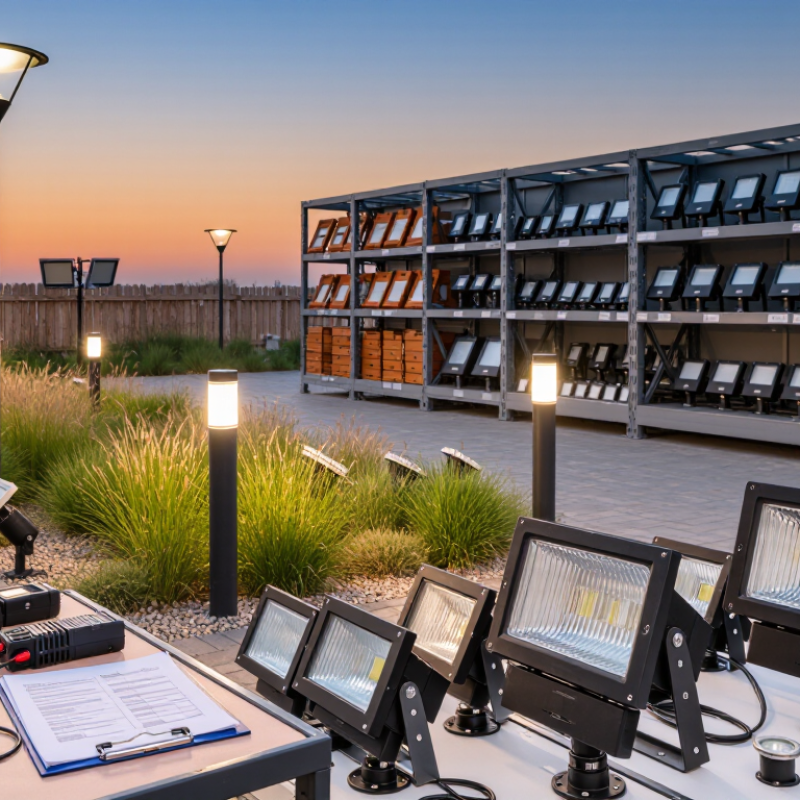
2026 Top Outdoor Lighting Suppliers in China?

What Defines a Leading Outdoor Lighting Supplier in China in 2026?

A leading outdoor lighting supplier in China in 2026 should prove performance, not merely promise it. The IEA reports that lighting uses about 15% of global electricity and produces roughly 5% of energy-related greenhouse gas emissions. These figures make efficiency and control quality practical purchasing concerns. Ask for independent photometric test reports, measured power consumption, and clear product specifications. A bright sample on a showroom wall proves little.

Outdoor fixtures face rain, heat, dust, and long operating hours. A reliable supplier should explain how each model is tested for ingress protection, corrosion resistance, thermal management, and driver compatibility. Request reports tied to the exact model, not a similar product. Check whether spare parts and warranty terms are documented. Small details matter: a poorly sealed cable entry can undermine an otherwise solid housing.

Manufacturing capacity matters, but so does engineering support. Can the supplier provide lighting calculations for a real road, garden, or parking area? Can it explain beam angles and glare risks in plain language? Ask how design changes are recorded between samples and mass production. I would still question any unusually high efficiency claim without test conditions; reports can be incomplete. Proof matters. Keep a sample, review the paperwork, and compare the delivered unit with the approved specification.

How China’s Outdoor Lighting Industry and Supply Chain Are Organized

China’s outdoor lighting supply chain is built from specialized steps, not one factory doing everything. Component makers produce LED modules, drivers, lenses, seals, and die-cast aluminum housings. Assemblers bring these parts together, then handle wiring, finishing, and product checks. Some suppliers focus on finished fixtures; others serve as component partners. The distinction matters.

Manufacturing is concentrated in coastal industrial regions, where suppliers can source metalwork, electronics, packaging, and logistics nearby. A bollard light may pass through several workshops before export: machining, powder coating, assembly, and inspection. Small details count. A poorly seated gasket or loose cable gland can compromise outdoor performance. Buyers should review test reports, sample consistency, and production controls, rather than relying on a catalogue alone.

The chain can move quickly, but it is not perfectly tidy. Component substitutions, shifting lead times, and uneven documentation can create surprises. Request a bill of materials and confirm whether key parts may change between sample and shipment. Ask how the supplier checks ingress protection and electrical performance, and whether those checks match the product specification. A factory visit can help, but clear written records matter too. There is no single “best” supplier; the right fit depends on project volume, technical requirements, and after-sales support.

Which Criteria Help Evaluate Outdoor Lighting Suppliers?

Choosing an outdoor lighting supplier starts with the project, not a catalogue. List the installation setting, expected operating hours, mounting height, and exposure to rain, dust, salt, or vibration. Ask for product data showing lumen output, beam angle, color temperature, power use, and ingress protection. A bright fixture is not automatically a good fit. Glare matters.

Check how the supplier verifies performance. Request test reports, sample units, and clear warranty terms; then compare the documents with the exact model being quoted. Inspect a sample after it has run for several hours. Note heat around the housing, uneven light, loose seals, and connector quality. Ask how drivers and other parts are sourced, and whether replacements remain available. Paperwork can look complete, yet one detail may still be unclear.

Production capability matters too. Confirm minimum order quantities, realistic lead times, packaging protection, and how defects are recorded and handled. For a pilot order, agree on inspection points before production, such as wiring, finish, and burn-in checks. Ask technical questions and observe how directly the supplier answers. A delayed reply is a signal, not proof of poor quality. No supplier is flawless; evaluate its evidence, communication, and willingness to correct problems. Even a careful review can miss something.

2026 Outdoor Lighting Supplier Evaluation: Understanding IP Ratings

Compare the two digits in common IP codes: the first indicates protection against solid objects and dust; the second indicates protection against water. Ratings are protection levels, not an overall supplier score.

When evaluating suppliers, request test documentation for the exact luminaire model and consider photometric reports, electrical safety compliance, efficacy, warranty terms, thermal performance, corrosion resistance, and product traceability. Under IEC 60529, IPX7 covers temporary immersion under specified conditions; IPX8 applies to immersion conditions agreed between the manufacturer and user.

Profiles of Notable Outdoor Lighting Suppliers in China

China’s outdoor-lighting suppliers often specialize in distinct product categories. Some focus on die-cast aluminum streetlights, while others produce bollards, garden fixtures, or solar-powered units. Their strengths show up in practical details: sealed cable entries, replaceable drivers, consistent powder coating, and clear installation drawings. A polished catalog is not enough. Ask how the supplier tests weather resistance and manages component changes between production batches.

A capable manufacturer may offer custom optics and housing dimensions for landscape projects. An export-oriented supplier may provide photometric files, wiring diagrams, and sample testing support. These profiles are useful starting points, not guarantees. Even a responsive team can have gaps in documentation or quality control. Details matter. Request recent test records and inspect a production sample before placing a large order.

Tips: Compare the same specifications across suppliers, including lumen output, color temperature, ingress protection, warranty terms, and spare-part availability. Confirm that quoted performance applies to the complete fixture, not just its LED chip. Ask who handles repairs after delivery. Then check the answers against physical samples; small finish differences can be easy to miss.

How to Compare Suppliers and Verify Products Before Purchasing

When comparing outdoor lighting suppliers in China, look beyond catalog prices. A low quote may exclude mounting brackets, surge protection, or packaging. Ask for a line-item quotation covering fixtures, drivers, cables, accessories, sample fees, and shipping terms. Compare the same wattage, beam angle, housing material, and control options. Otherwise, the numbers can mislead.

Request a production sample matching the proposed model, not just a similar showroom unit. Check housing thickness, gasket seating, cable entry, and finish up close. Ask for test reports tied to the exact model and component list; verify report dates and laboratory details. Review ingress protection, impact resistance, thermal performance, and corrosion testing where relevant. Reports help, but they do not replace your own checks. A polished sample is not proof of consistent production—a tempting assumption, and an easy one to regret.

Tips: Test the sample outdoors after rain, then inspect for moisture and loose seals. Ask who handles warranty claims, what parts are stocked, and how defects are documented. Get lead times and quality-control steps in writing. Even careful checks can miss something; keep a clear record of approved specifications and sample changes.

2026 Top Outdoor Lighting Suppliers in China? - How to Compare Suppliers and Verify Products Before Purchasing

Use this evidence-based scorecard to compare outdoor-lighting suppliers without relying on unverified rankings or company claims. The criteria below are procurement checks, not ratings of any specific supplier. Set project-specific requirements before comparing quotations.

Comparison Dimension What to Request from Each Supplier How to Verify It Practical Evaluation Point
Product and application fit Product datasheet, installation instructions, proposed mounting arrangement, operating temperature range, and intended application (such as road, area, façade, or landscape lighting). Check that the quoted model, drawings, accessories, and installation conditions match the project specification. Confirm that the supplier is quoting a production model rather than an unapproved sample configuration. Match to project
Record any deviations from the requested specification before comparing prices.
Ingress protection IP rating for the complete luminaire and the test report or certificate identifying the tested product and configuration. Check the report against IEC 60529 and confirm that its model number, enclosure, cable entries, gaskets, and assembly match the offered product. An IP rating describes protection against access, solid objects, and water under specified test conditions; it does not establish corrosion resistance or impact resistance. Verify the exact model
Choose the required IP level based on exposure and project conditions.
Impact resistance IK rating and supporting test evidence, where impact protection is relevant to the installation. Check the stated classification against IEC 62262 and confirm that the tested housing, lens, and assembly correspond to the quoted luminaire. Do not treat an IP rating as a substitute for an IK rating. Application-dependent
Specify an IK requirement where vandalism or mechanical impact is a foreseeable risk.
Photometric performance IES or LDT photometric file, lumen output, input power, efficacy, beam distribution, CCT, CRI, and measurement report for the proposed configuration. Check that the photometric file matches the exact optics and LED configuration being quoted. Use the file in the project lighting calculation; compare delivered light and distribution, not wattage alone. Compare like for like
Confirm whether stated lumens are luminaire output or LED-source values.
LED lifetime claims LED-package LM-80 data and any TM-21 projection used to support a lumen-maintenance claim, plus the stated operating temperature and assumptions. Check that the data applies to the LED package and drive current in the proposed design. LM-80 concerns LED-source lumen maintenance under defined test conditions; it is not, by itself, a test of complete-luminaire lifetime. Review driver, thermal, and environmental evidence separately. Review assumptions
Do not accept a lifetime figure without its metric, conditions, and supporting documentation.
Electrical and safety documentation Applicable safety and electrical test reports, wiring diagrams, driver specifications, and declarations required for the destination market. For luminaires, check the relevance of IEC 60598-1 and applicable product-specific requirements. Verify the issuing laboratory, report number, date, model coverage, and destination-market requirements. A document or mark alone does not prove that every offered configuration was tested. Check market scope
Confirm documentation for the actual model and sales destination.
EMC and photobiological safety Applicable EMC reports and, where relevant, photobiological safety assessment for the product configuration. Check whether reports cover the proposed driver and control equipment. Standards that may be relevant include IEC 61547 for EMC immunity, IEC 61000-3-2 for harmonic current emissions, and IEC 62471 for photobiological safety; applicability depends on the product and market. Confirm applicability
Ask for reports tied to the configuration rather than a generic document set.
Materials and corrosion protection Housing and lens material specifications, coating details, fastener material, and any corrosion-test evidence relevant to the installation. Check the bill of materials and test conditions. For coastal or industrial sites, ask whether the evidence represents the specified finish and complete assembly; a generic IP rating does not establish corrosion performance. Site-specific review
Assess salt, humidity, pollutants, UV exposure, and maintenance conditions.
Controls and dimming Control protocol, wiring details, dimming range, compatible control gear, sensor options, and commissioning requirements. Confirm compatibility with the project control system and request a functional test using the intended controller or interface. Check fail-safe behavior and the impact of controls on warranty terms. Test interoperability
Include controls and commissioning in the sample or pilot test.
Quality management and traceability Quality-system documentation, inspection plan, lot identification method, and sample inspection or production records. Check the scope and validity of any quality-system certificate with its issuer. Ask how incoming components, in-process checks, final tests, and nonconforming products are controlled. A quality-system certificate is not a product-performance test. Assess the process
Look for traceability from the shipped lot to inspection records.
Sample and production consistency Pre-production sample, approved drawings, bill of materials, labeling details, and a written change-control process. Approve a reference sample and compare production goods against it. For critical projects, arrange an agreed inspection plan and test selected units before shipment. Control changes
Document permitted substitutions and require approval for material or component changes.
Warranty and after-sales support Written warranty terms, exclusions, claim process, spare-parts policy, and technical-support contact procedure. Review the terms for duration, covered components, remedy, shipping responsibilities, and exclusions. Ask the supplier to clarify how claims are handled for the destination market. Compare terms
Evaluate the written remedy and support process, not just the warranty headline.
Commercial and delivery capability Itemized quotation, stated Incoterm and named place, lead-time basis, packaging details, minimum order quantity, and payment terms. Compare quotations on the same technical configuration and delivery basis. Confirm whether tooling, testing, accessories, packaging, and export documents are included. Normalize quotations
Separate product cost from freight, duties, testing, and project-specific services.
Supplier verification Business registration details, factory address, manufacturing scope, and permission to conduct a factory or third-party audit. Check business information through appropriate official or independent channels, and confirm that the audited site is the site responsible for the quoted production. Verify certificates and reports directly with the issuer where possible. Verify independently
Distinguish a manufacturer from a trading or sourcing intermediary where this matters to the project.

Before placing a purchase order: shortlist suppliers using the same specification, verify model-specific documents, approve a representative sample, and agree on inspection criteria in writing. Standards and certification requirements vary by product and destination market; confirm the applicable requirements with the project’s qualified compliance or testing team.

FAQS

What should a dependable outdoor lighting supplier prove?

It should provide independent test reports, measured power use, and exact product specifications. A bright sample alone proves little.

Which product details should buyers check?

Review lumen output, beam angle, color temperature, power use, and ingress protection. Glare matters.

How can I check whether a fixture suits its installation site?

Share the mounting height, operating hours, and exposure to rain, dust, salt, or vibration. Ask for lighting calculations based on the actual site.

What should testing documents identify?

Reports should match the exact model being quoted. Similar-model reports can leave important questions unanswered.

What can a sample reveal beyond its appearance?

Run it for several hours. Check housing heat, uneven light, loose seals, cable entries, and connector quality. Small details count.

How should I assess production and delivery?

Confirm order quantities, realistic lead times, protective packaging, and defect-handling procedures. Agree on inspection points before production starts.

What should I ask about repairs and warranty support?

Request written warranty terms and ask whether replacement drivers and other parts will remain available. Paperwork can still miss a detail.

How should a supplier handle unusually high efficiency claims?

Ask for the test conditions and measured results. I might still question a polished report if its methods are unclear. No review catches everything.

Conclusion

This article explores what distinguishes a leading outdoor lighting supplier in China in 2026, from product expertise and manufacturing capabilities to quality control, customization, and communication. It also explains how the industry’s supply chain is organized, including the different roles played by manufacturers, component providers, and trading companies. Understanding these roles can help buyers identify suppliers whose capabilities match their project requirements.

The article outlines practical criteria for evaluating suppliers, such as product specifications, materials, testing processes, production capacity, and after-sales support. It also introduces several types of notable suppliers without focusing on brand names, then offers a structured approach to comparing potential partners and verifying products before purchase. By checking samples, documentation, manufacturing details, and project experience, buyers can make more informed decisions. Ultimately, How to choose a reliable outdoor lighting manufacturer in China? starts with clear requirements, careful verification, and direct, consistent communication.

Sienna

Sienna

Sienna is a skilled marketing professional with a deep expertise in our company’s core products and services. With a passion for innovation and detail, she plays a pivotal role in crafting insightful blog posts that not only highlight the unique features of our offerings but also provide valuable......