Why Is CCT Important for Road Safety?
Why is CCT (Color Temperature) important for road safety? This question matters wherever drivers, cyclists, and pedestrians share limited night-time visibility. Correlated Color Temperature influences how road scenes appear under artificial light. Lower-CCT lighting often looks warmer, while higher-CCT lighting appears cooler and whiter. These differences can affect contrast, color recognition, visual comfort, and hazard detection.
Dr. John Bullough, a lighting researcher at Rensselaer Polytechnic Institute, has emphasized, “Good road lighting is not just about brightness; it is about visibility, contrast, and visual comfort.” His point is practical. A driver approaching a wet junction needs to distinguish lane markings, reflective signs, brake lights, and a person near the curb. CCT can influence that visual experience, but it cannot solve every problem.
The right choice depends on more than a number.
Lamp quality, glare control, uniformity, weather, road geometry, and maintenance also matter. A very cool light may improve perceived sharpness, yet it can create discomfort or unwanted glare. A warmer light may feel calmer, but some colors could appear less distinct. Evidence is still developing, and local conditions deserve careful testing rather than simple assumptions. Field measurements and driver feedback should guide final decisions. This article examines how CCT interacts with visibility, human perception, and responsible road-lighting design. It also considers an uncomfortable truth: brighter or whiter lighting does not automatically mean safer streets.
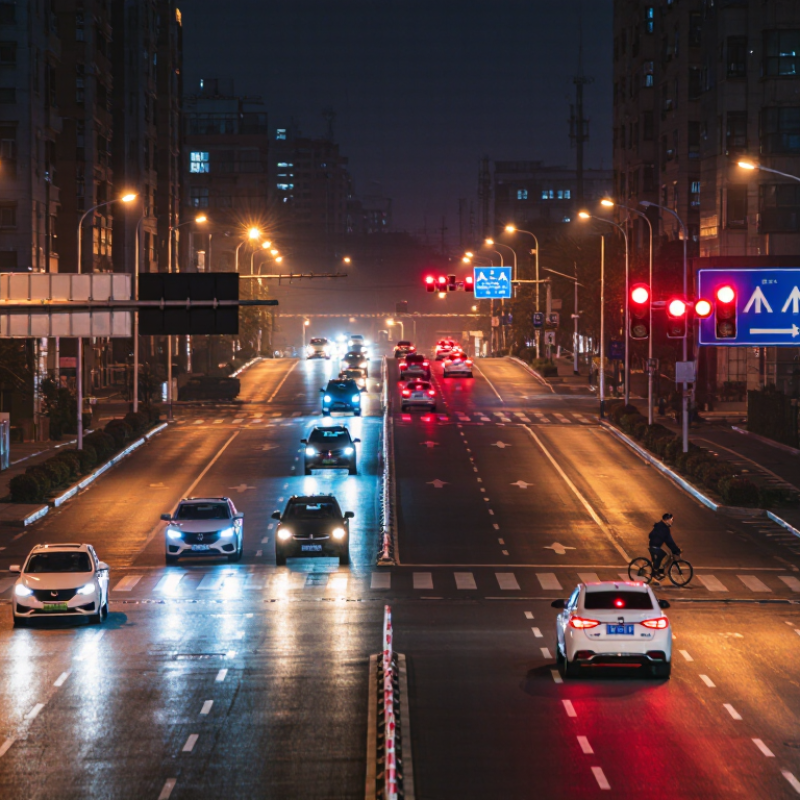
What CCT Means in Road Lighting
Why Is CCT Important for Road Safety?
What CCT Means in Road Lighting
Correlated Color Temperature, or CCT, describes how road lighting appears to the eye. It is measured in kelvin. Lower values, such as 2700K or 3000K, look warmer and more amber. Higher values, such as 4000K or 5000K, appear cooler and bluer. CCT does not measure brightness. It also does not describe the full light spectrum. That distinction matters during real nighttime driving.
The International Commission on Illumination explains that low-light vision changes as illumination decreases. Its CIE 191:2010 model covers mesopic conditions from approximately 0.005 to 5 cd/m². Under these conditions, human vision relies on both rods and cones. A suitable spectrum may improve visual detection, but excessive blue content can increase discomfort glare and nighttime concerns. A cooler lamp is not automatically safer. It may even create harsher reflections on wet asphalt.
Road designers should connect CCT with illuminance, uniformity, glare control, and pavement conditions. IES RP-8 treats these factors as part of roadway lighting design, rather than treating color appearance alone as a safety solution. The World Health Organization reported about 1.19 million road deaths worldwide in 2021, with millions more suffering non-fatal injuries. Lighting cannot solve every crash risk, but poor visibility can make hazards harder to recognize. Field observations often reveal an uncomfortable truth: a technically compliant installation may still feel tiring or confusing to drivers. CCT selection needs measured performance, local climate data, and feedback from nighttime users.
How CCT Affects Visibility and Hazard Recognition
Correlated colour temperature (CCT) describes whether light appears warm, neutral, or cool. It is measured in Kelvin. For road safety, CCT affects how quickly drivers recognise people, signs, lane markings, and unexpected objects. Neutral-white lighting can make edges and colours appear clearer at night. This may help a driver notice a cyclist near a dark roadside. However, CCT is not a magic setting. Brightness, beam control, colour rendering, weather, and driver vision also matter.
In clear conditions, cooler light may reveal contrast on dry pavement. Yet wet roads can reflect it sharply, creating glare and eye fatigue. Fog and rain scatter shorter blue wavelengths, sometimes reducing useful visibility. Warmer light may feel more comfortable in these conditions, but it can make some colours less distinct. Road-lighting assessments should examine real streets, not only laboratory measurements. I have found that a seemingly brighter scene is not always easier to read. That assumption deserves more testing.
Tips
Choose CCT with the local climate in mind. Test lighting during rain, fog, and dry darkness. Check whether signs and markings remain recognisable from a safe driving distance. Reduce glare through careful aiming and shielding. Compare several CCT options before installation. Do not judge safety by colour alone. Driver feedback can expose problems that measurements miss.
Why Is CCT Important for Road Safety?
How correlated color temperature affects visibility and hazard recognition
Correlated color temperature (CCT) describes the apparent color of white light. Warm white light is generally below 3,300 K, neutral white light is approximately 3,300–5,300 K, and cool white light is above 5,300 K.
CCT can influence visual contrast, color appearance, and driver adaptation, but it does not independently determine hazard-recognition performance. Illuminance, glare control, spectral distribution, color rendering, weather, road geometry, and driver adaptation also have a significant effect on visibility and reaction time.
The Relationship Between CCT and Driver Response Time
Why Is CCT Important for Road Safety?
The Relationship Between CCT and Driver Response Time
Correlated colour temperature, or CCT, describes whether road lighting appears warm or cool. Lower values look amber, while higher values appear whiter or slightly blue. This difference can influence how quickly drivers notice lane markings, pedestrians, and unexpected objects.
Driver response time includes seeing, understanding, deciding, and reacting. Clearer visual contrast may shorten the first stage. In field assessments, moderately cool lighting can help drivers identify details sooner, especially on poorly lit roads. That matters. A driver approaching at night may gain a brief moment when a cyclist’s outline becomes visible earlier.
However, higher CCT does not automatically create safer roads. Excessive blue-rich light can increase glare, discomfort, or visual strain. Wet pavement may reflect bright light into the driver’s eyes, reducing useful contrast. Age, fatigue, weather, speed, and windshield condition also affect response time. CCT is only one factor.
The evidence is not perfectly uniform. Some drivers may respond well to neutral-white lighting, while others prefer warmer illumination. Road assessments should measure visibility and real reaction behaviour, not colour temperature alone. I would avoid claiming that one CCT suits every location. Lighting tests should include dry and wet surfaces, approaching headlights, pedestrian visibility, and nighttime driver feedback. Small design compromises can matter. Safety depends on the whole visual environment.
Why Is CCT Important for Road Safety? - The Relationship Between CCT and Driver Response Time
A research-informed comparison of correlated color temperature, visual conditions, and driver response considerations
| CCT Range |
Typical Light Appearance |
Potential Road-Safety Benefit |
Potential Limitation |
Relationship to Driver Response Time |
Evidence Interpretation |
| 2,700–3,000 K |
Warm white |
Lower blue-light content and generally comfortable visual conditions at night. |
Some cool-colored objects, markings, and low-contrast hazards may appear less visually distinct. |
May support comfortable detection, but CCT alone does not establish a specific reduction in reaction time. |
Useful when glare control, visual comfort, and environmental sensitivity are priorities. |
| 3,000–4,000 K |
Neutral to slightly warm white |
Balances color recognition, visual comfort, and roadway contrast under many outdoor conditions. |
Actual visibility still depends strongly on illuminance, uniformity, glare, weather, and pavement reflectance. |
Can support faster hazard recognition when contrast and uniformity are adequate; no fixed CCT-to-time conversion is validated. |
Often considered a practical range for balancing visibility and visual comfort, subject to site-specific assessment. |
| 4,000–5,000 K |
Cool white |
May improve the apparent sharpness of some high-contrast objects and help distinguish certain colors. |
Can increase perceived glare or discomfort if intensity, optics, or mounting geometry are poorly controlled. |
Possible improvement in visual detection does not automatically produce a shorter braking response. |
Benefits are conditional on good glare management and suitable luminance distribution. |
| 5,000–6,500 K |
Daylight white |
May provide strong color differentiation and a daylight-like appearance in some visual tasks. |
Higher short-wavelength content may increase discomfort, disability glare, or ecological concerns in unsuitable applications. |
There is no reliable evidence that this range alone guarantees faster driver responses in real traffic. |
Should be evaluated together with glare, spectrum, exposure duration, and roadway geometry. |
| All CCT Values |
Varies by lamp spectrum |
Appropriate lighting can improve object detection, lane visibility, sign recognition, and pedestrian conspicuity. |
Poor uniformity, excessive glare, wet pavement, fog, driver age, fatigue, and distraction can outweigh CCT effects. |
Driver response time is determined by perception, decision-making, and vehicle-control actions; CCT is only one environmental variable. |
No universal numeric relationship between CCT and driver response time has been established. |
Driver Response-Time Reference Values
| Response Measure |
Reference Value |
Meaning for Road Safety |
| Simple visual reaction |
Approximately 0.20–0.25 seconds in controlled laboratory tasks |
Represents a basic response and is shorter than the time normally required for a driver to detect, interpret, and act on a roadway hazard. |
| Design perception-reaction time |
2.5 seconds is commonly used for conservative stopping-sight-distance design |
Includes hazard perception, decision-making, and the initial braking response under roadway-design assumptions. |
| Effect of CCT |
No universally accepted fixed time improvement |
CCT may influence visual comfort and object visibility, but lighting quality must be assessed using glare, uniformity, illuminance, contrast, and spectrum together. |
Key takeaway: CCT can influence the visual appearance of roadway lighting and may affect contrast perception, color recognition, and discomfort glare. However, it should not be treated as a direct or standalone predictor of driver response time.
Reference basis: roadway lighting and stopping-sight-distance principles published by transportation engineering authorities, together with established human-factors research on visual reaction and perception-reaction time.
CCT, Glare, Weather, and Nighttime Driving Conditions
Correlated Color Temperature (CCT) describes whether road lighting appears warm, neutral, or cool. Lower CCT light looks more amber, while higher CCT light appears whiter or bluer. CCT can influence visual comfort, but it does not measure brightness, beam control, or overall safety. A careful road assessment must consider all these factors together.
Glare becomes dangerous when bright lamps enter a driver’s direct view or reflect from wet surfaces. High-CCT lighting may appear crisp, yet excessive blue content can feel harsh during dark driving. On a rainy night, lane markings may disappear beneath shining reflections. Snow, fog, and dust can scatter light and create a pale veil across the windshield. Lower CCT lighting may reduce some discomfort, but it cannot solve poor aiming or excessive intensity. The fixture’s optical design matters more than color alone.
Traffic engineers commonly evaluate luminance, uniformity, visibility distance, and driver reaction time. Practical checks should include clean and dirty windshields, dry and wet pavement, and different vehicle heights. A light that seems comfortable from the roadside may still trouble an approaching driver. That is an easy mistake. I would avoid choosing CCT from appearance alone. Night drivers need enough contrast to detect pedestrians, signs, and sudden obstacles without facing sharp visual strain. Weather data and local road geometry should guide the final decision, because one setting may not suit every street.
Choosing Safer CCT Levels for Different Road Environments
Why Is CCT Important for Road Safety?
Choosing Safer CCT Levels for Different Road Environments
Correlated colour temperature, or CCT, affects how drivers see road markings, pedestrians, and hazards at night. However, a higher CCT does not automatically create safer lighting. Bright, bluish light may improve visual sharpness, but it can also increase glare, discomfort, and reflections on wet asphalt.
Different roads need different choices. In residential streets, a warmer CCT around 2700K to 3000K can support comfortable visibility near homes, crossings, and footpaths. It may also reduce unnecessary sky glow. Busy urban intersections often benefit from a neutral CCT near 3500K to 4000K, especially where signs, cyclists, and turning traffic compete for attention. Rural roads require more caution. A moderate CCT can reveal roadside movement without making dark surroundings appear harsh or distracting.
Tunnel entrances, bends, and pedestrian crossings deserve separate assessment. Engineers should examine luminance, uniformity, glare, weather, mounting height, and driver age. CCT should support these measurements, not replace them. On wet roads, a seemingly clear light can still produce troubling reflections. That detail is easy to miss.
Field reviews should include night observations and local feedback. A technically acceptable setting may feel uncomfortable in practice. Road authorities should test small sections, compare results, and adjust when evidence suggests a better balance. Safer lighting is not simply whiter lighting. It is lighting matched to the road, the users, and the surrounding darkness.
FAQS
CCT describes whether light appears warm, neutral, or cool. It is measured in Kelvin. Lower values look amber, while higher values look whiter or slightly blue.
Neutral-white lighting may clarify edges, colours, signs, and lane markings. A cyclist beside a dark roadside may become visible sooner. CCT is not magic.
No. Bluish light may sharpen contrast on dry pavement but increase glare on wet asphalt. Safety depends on brightness, beam control, weather, and driver vision.
Rain can reflect bright light directly toward drivers, causing eye fatigue. Fog scatters shorter blue wavelengths and may reduce useful visibility. Warmer light can feel more comfortable, but colours may appear less distinct.
Warmer lighting around 2700K to 3000K may support comfortable visibility near homes and footpaths. It can also reduce unnecessary sky glow. Local testing remains important.
Neutral lighting near 3500K to 4000K may help reveal signs, cyclists, and turning traffic. Glare control still matters. A brighter intersection can become visually tiring.
Driver response includes seeing, understanding, deciding, and reacting. Clearer contrast may shorten the seeing stage. A brief gain can matter near a crossing or bend.
They should compare several settings on real roads during dry darkness, rain, and fog. Check markings and signs from a safe driving distance. Include glare, wet reflections, driver age, and local feedback. Measurements can miss discomfort.
Conclusion
Why is CCT (Color Temperature) important for road safety? Correlated Color Temperature (CCT) describes the visual appearance of road lighting, from warmer yellowish tones to cooler bluish-white light. It influences how clearly drivers can see lane markings, pedestrians, road signs, obstacles, and changes in the road surface. An appropriate CCT can improve contrast and support faster hazard recognition, helping drivers respond more confidently and reducing the time needed to react to unexpected situations.
However, higher CCT is not always safer. Excessively cool light may increase glare, visual discomfort, and reflection from wet roads, fog, rain, or snow. Warmer light may provide better comfort in some environments, while neutral or moderately cool light may improve clarity on major roads and intersections. Selecting CCT should therefore consider traffic speed, surrounding development, weather, road layout, and nighttime visibility. The safest approach is to balance visual clarity, glare control, and driver comfort for each specific road environment.

 Rhynox Lighting